

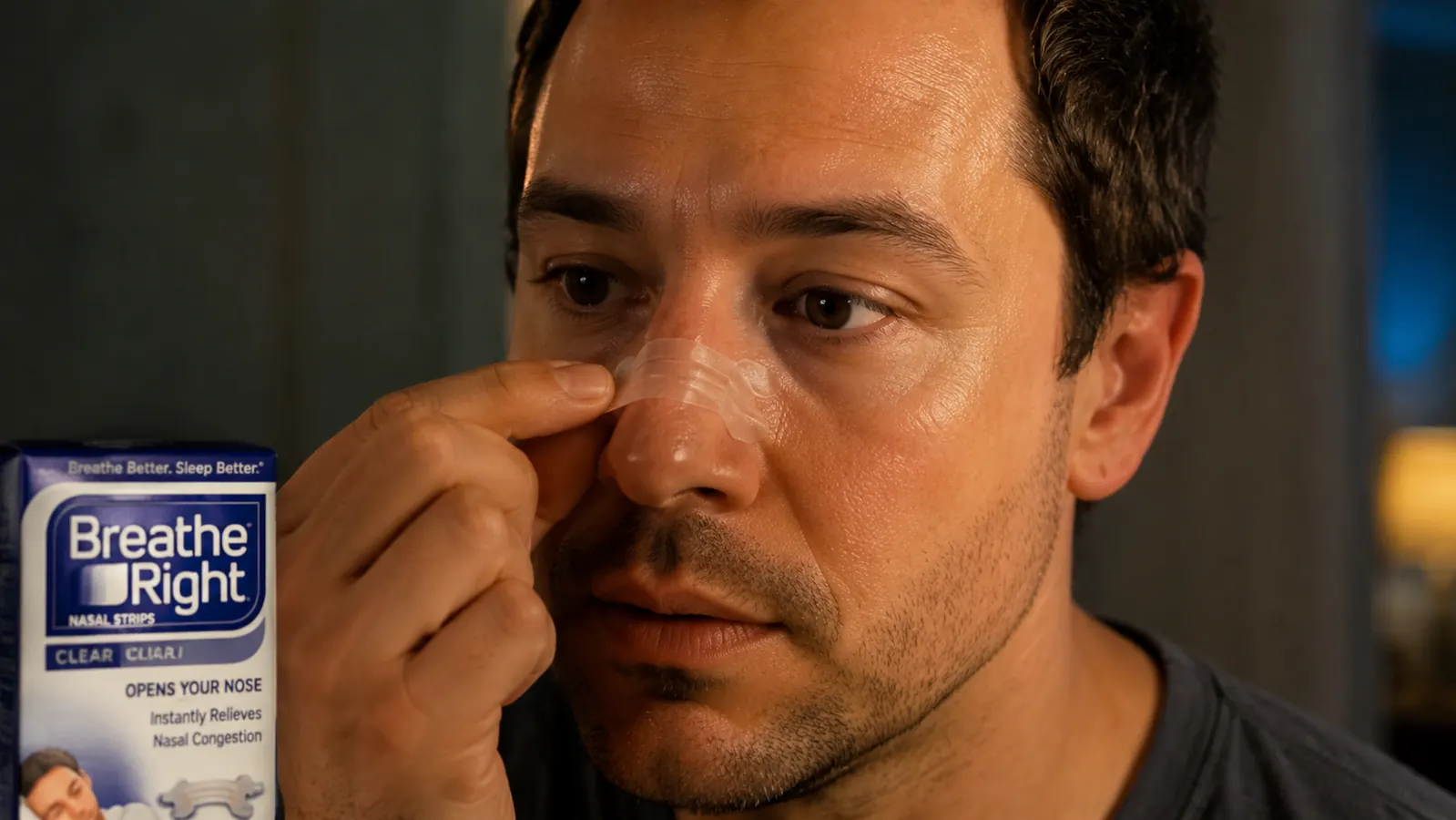
The first thing nobody tells you about Breathe Right strips is what your nose looks like at 6:15 in the morning when you peel one off too fast. I found that out about three weeks into using them, hunched over the bathroom mirror while Jonah banged on the door asking why I looked like I'd been in a fight. There was a faint red rectangle across the bridge of my nose, right where the adhesive had gripped all night, and it took a good twenty minutes to fade before I could leave the house without Casey asking what happened to my face.
That's the part of this review nobody puts on the box. I've now put in close to five months of near-nightly use of the Breathe Right Extra Strength Clear strips, the same ones my brother-in-law swears by for the congestion he gets training for his fall races, and I want to walk through the stuff that actually surprised me: the skin marks, the nights it came loose or fell off completely, what it really costs to run this every single night, and the honest difference between fixing a stuffy nose and fixing snoring, because those are two different problems and most reviews blur them together.
The Quick Verdict
It works, and it works better on a stuffy nose than on snoring specifically. But it comes with real adhesive quirks, an ongoing per-night cost, and a learning curve most reviews skip right past.
Amazon Check Today's Price →Before you book a specialist visit, spend a fraction of that on the cheapest possible test.
A single strip tells you in one night whether your congestion is even the kind that responds to opening your nostrils wider. That's information worth having before you spend more.
Amazon Check Today's Price on Amazon →How I Actually Wear These, Warts and All
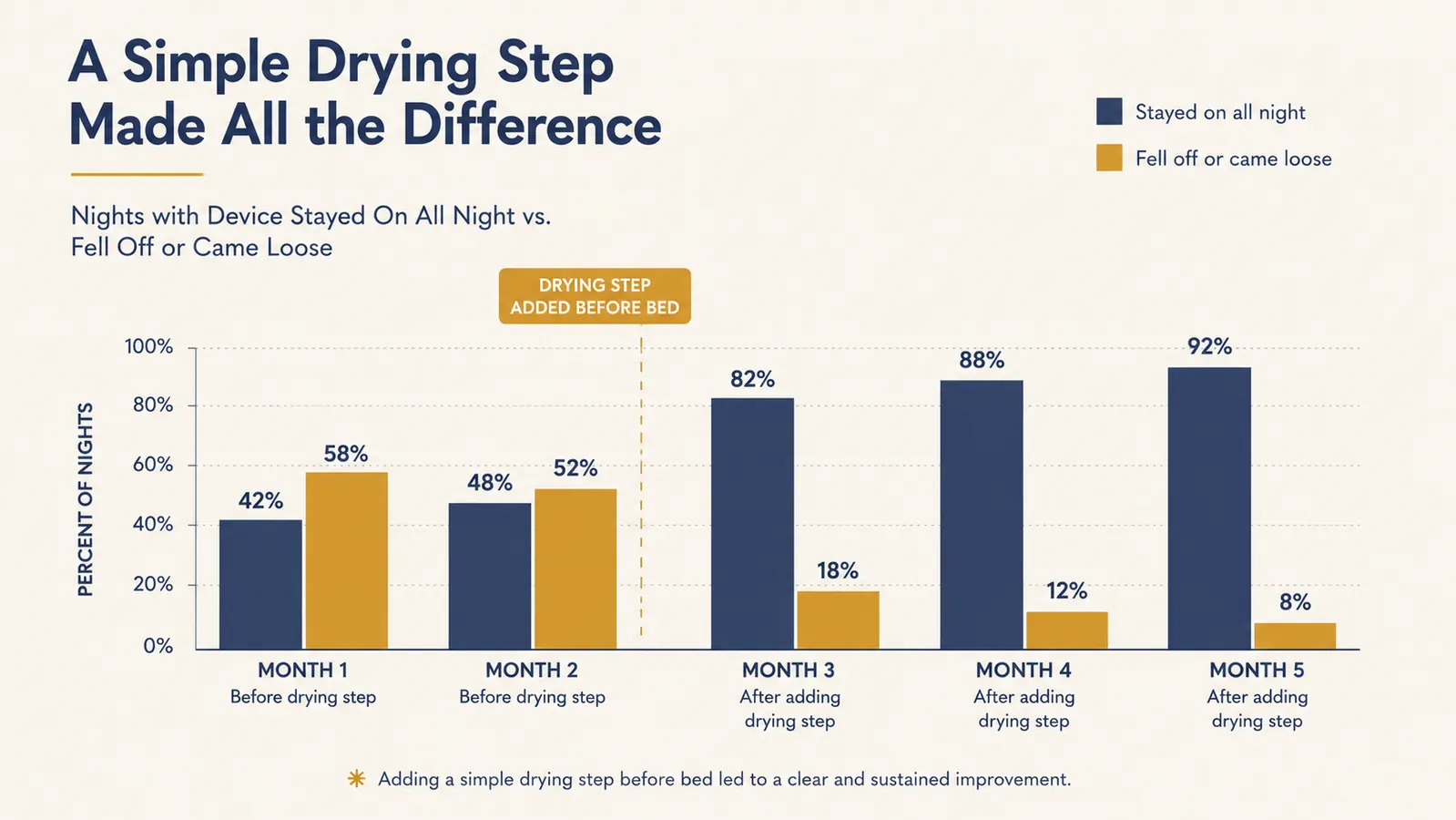
My first week was nothing like the smooth experience I expected from reading other reviews. I pressed the Breathe Right strip on straight out of the shower a couple of nights because I was rushing to get the kids down, and both times I woke up with it half hanging off my face, stuck more to my pillowcase than to my nose. It took me embarrassingly long to connect the dots that damp skin was the problem, not a bad batch of strips.
Once I started waiting a full two minutes after washing my face, patting it completely dry with a hand towel instead of just air drying, the hold got dramatically better. But even with that fixed, I noticed something the marketing never mentions: the exact same spot on my nose gets pressed on and peeled off every single night, and skin doesn't love that kind of repetition forever. Most mornings it's fine. Some mornings, especially after a night where I slept hot or shifted around more than usual, I get that faint red outline that fades within half an hour but is definitely visible if Casey catches me before coffee.
Emma thinks the whole routine is funny and has started calling the red mark my "nose tan line," which is a better name for it than anything I'd come up with. I mention that only because it's the kind of small, honest detail that never shows up in a five-star Amazon review, and it's exactly the kind of thing I'd want to know before I bought a box.
The Adhesive Marks Nobody Mentions
I have fair, easily irritated skin, and this box is labeled for sensitive skin specifically, so I went in expecting the gentlest version of this product to be a non-issue. It mostly is. I want to be clear that I never got a rash, never had peeling skin, and never had to stop using the strips because of irritation. What I did get, on maybe one out of every eight or nine mornings, was that temporary reddened rectangle where the adhesive had gripped hardest, usually on nights I'd slept warmer than normal or tossed around more.
The mark is never painful. It's closer to the kind of faint line you get from sleeping on a wrinkled pillowcase, and it's always gone by the time I've finished breakfast. But if you're someone who has an early morning video call or you're self-conscious about your skin, it's worth knowing that "sensitive skin" adhesive still means adhesive, and adhesive that holds through eight hours of side sleeping is going to leave some evidence behind on the mornings your skin is a little more reactive than usual.
The extra strength version pulls noticeably harder than I expected the first time I tried it, which makes sense since that's the entire point of the stiffer internal bands, but it also means the removal in the morning has more bite to it than a gentler strip would. I've gotten into the habit of peeling slowly from one side rather than ripping it off, which cuts down on both the sting and the redness by a real margin.
The Nights It Fell Off Completely
Dry skin nights are one thing. The bigger issue for me has been sweat, and I don't mean a light overnight warmth, I mean the nights our bedroom runs hot because I forgot to adjust the thermostat, or the nights I go for a jog after the kids are in bed and shower late. On those nights the strip has a real fight on its hands, and more than once it's lost. I've woken up with it curled up at one edge like a sticky note that's given up, still technically attached but doing nothing useful.
There was one stretch in month three, right in the middle of a stretch of unusually warm nights, where I lost the strip entirely on four separate mornings, finding it stuck to my pillow instead of my face. That's the kind of failure rate that would frustrate anyone paying attention, and it's exactly the kind of thing a glowing five-star review tends to leave out.
The fix, once I found it, was simple but non-negotiable: fully dry skin before application, every single time, no exceptions for being tired or in a hurry. I also learned to avoid putting on any facial moisturizer or leftover sunscreen near the bridge of my nose before bed, since even a thin residual layer cuts the hold time noticeably. Since I started treating that drying step as mandatory rather than optional, my fall-off nights have dropped to maybe one a month, usually still tied to an unusually warm or sweaty night.
If you run hot at night, sleep with the heat up for a partner who gets cold, or you're someone who exercises close to bedtime, go in expecting to manage this the same way I did. It's not a dealbreaker, but it's a real maintenance step, not a minor footnote.
What This Actually Costs Per Night
This is a disposable product, and that math matters more than most reviews bother to spell out. A single box gets you 44 strips, and if you're wearing one every night the way I have been, that's about six weeks of coverage per box before you're back at the store or reordering online. Do the rough math on a box like that at today's price and you land at well under a dollar a night, which is closer to pocket change than a subscription bill, but it is still an ongoing cost that never goes away the way a one-time purchase would.
Compare that to a reusable internal nasal dilator, which you buy once and reuse indefinitely, and the math flips the other way over a long enough timeline. I've run both side by side in a separate comparison if you want the full breakdown, but the short version is this: if you hate the idea of restocking the same small box every six weeks for the rest of your life, that's a legitimate reason to at least consider the reusable route, even though it comes with its own tradeoffs around comfort and fit.
For me, the low per-night cost has been easy to justify given how much quieter my nights have gotten, but I'd be lying if I said I never notice the box getting lighter faster than I expect, especially during allergy season when I'm sometimes tempted to double up.
Snoring Fix or Just a Clearer Nose? The Honest Difference
This is the distinction that I think trips up the most buyers, and it tripped me up too before I paid closer attention. The strip does one specific mechanical thing: it pulls the outer walls of your nostrils outward, physically widening the passage on the outside of your nose. That's a nasal congestion fix first and a snoring fix second, and the two only overlap when your snoring is actually caused by nasal restriction in the first place.
In my case, a good chunk of my snoring does come from a mildly narrow passage on one side, so opening it up genuinely quiets things down most nights, and Casey has confirmed that plenty of times without me asking. But on nights when my nose is completely clear and I still snore anyway, usually after a late dinner or a couple drinks with friends, the strip does basically nothing for the noise. That kind of snoring is coming from somewhere further back in my throat, and no amount of nostril widening touches that.
If you're buying this specifically hoping it silences all snoring regardless of cause, temper that expectation now. It's a genuinely good tool for congestion-driven snoring and mouth breathing from a stuffy or slightly narrow nose. It is not a universal snoring fix, and I'd rather tell you that plainly than let you find out after your money's already spent and you're disappointed it didn't work the one night it mattered most, like the night before an early flight when I'd had wine with dinner and snored right through the strip anyway.

Extra Strength and Sensitive Skin: My Real Experience
I specifically picked the Extra Strength Clear version because the regular strength didn't feel like it was doing enough for me during allergy season, but it's worth being honest about what "extra strength" actually means here. The internal plastic bands are stiffer, which means more pulling force on your nostrils and, by extension, more pulling force on your skin during both application and removal.
The first two or three nights, I noticed a slight tugging sensation strong enough that it woke me up briefly when I rolled onto my side and put pressure on the bridge of my nose against the pillow. That faded as I got used to the sensation, but if you have genuinely sensitive skin rather than just skin that reacts occasionally like mine, I'd suggest starting with the regular strength strip and only stepping up to extra strength if you find you actually need the stronger pull. Going straight to the strongest option because it sounds like the best value isn't necessarily the right call for every nose.
What I Liked
- Genuinely reduces congestion-driven snoring and mouth breathing when your nose, not your throat, is the source of the problem
- Low per-night cost even factoring in it being fully disposable
- No medication, nothing to build a tolerance to, works the same the fiftieth night as the first
- Sensitive-skin adhesive that never caused lasting irritation across five months, only occasional temporary marks
- Simple to test in a single night before committing to a bigger fix
Where It Falls Short
- Leaves a temporary red mark on the skin some mornings, especially after warm or restless nights
- Comes loose or falls off entirely on nights with sweat, heat, or leftover moisturizer near the nose
- Ongoing nightly cost since every strip is single use, unlike a reusable device
- Does nothing for snoring that comes from the throat rather than the nose
- Extra strength version pulls harder, which some sensitive noses may want to ease into rather than start with
It fixed the nights my nose was the problem. It did nothing for the night wine was the problem. Knowing which one you actually have matters more than the strip itself.
Who This Is For
This is a solid pick if your snoring or nighttime stuffiness is genuinely coming from a narrow or congested nasal passage, whether that's seasonal allergies, a cold, or a structural quirk like the one my allergist flagged for me. It's also a smart, low-risk way to test that theory before you spend more money or time on anything bigger, since a single strip on a single bad night will tell you a lot about whether nasal restriction is actually your issue.
It's a reasonable fit too if you don't mind an ongoing small cost in exchange for not having to fit or maintain a reusable device, and if you're willing to build in the extra step of drying your skin fully before bed. Five months in, I still reach for it first on nights I know my allergies are flaring, red mark risk and all.
Who Should Skip It
Skip this if your snoring shows up even on nights your nose is completely clear, since that's a strong sign the noise is coming from your throat, not your nostrils, and this product simply won't touch it. It's also not the right call if you sweat heavily overnight or run consistently hot in bed, since you'll be fighting the adhesive more nights than not unless you're diligent about drying your skin every single time, which gets tiring fast.
If you've been told you have moderate to severe sleep apnea, this isn't a substitute for whatever your doctor has recommended, it's at most a minor add-on to that plan. And if visible redness on your face, even temporary, is something you'd rather avoid entirely, a reusable internal dilator that sits inside the nostril rather than pulling on the skin outside it might suit you better, even with its own tradeoffs around comfort.
One honest strip test tells you more than another month of guessing.
It won't fix everything. But for a nose-driven snoring or congestion problem, it's the cheapest, fastest way to find out if you're even fighting the right battle.
Amazon Check Today's Price on Amazon →