

My allergist told me flat out, back in the spring, that my septum leans enough to one side that I'll probably always breathe a little worse through my left nostril than my right. She wasn't recommending surgery, just explaining why I wake up some mornings feeling like I ran a race in my sleep. That same week I grabbed a box of Breathe Right Extra Strength strips from the pharmacy on a whim, mostly because Casey had started sleeping with a pillow over her head again and I knew exactly why.
Six months later I've gone through more boxes of these clear Breathe Right strips than I can count sitting on my nightstand right now, and I finally have enough nights logged to say something more useful than "they seemed to help." I wore one every single night, cold season, allergy season, and the boring stretches in between, and I tracked how I felt in the morning the whole way through.
The Quick Verdict
A genuinely simple, drug-free way to open up your nose at night. Not a cure for a real anatomical block, but it noticeably reduced my mouth breathing and quieted my snoring more nights than not.
Amazon Check Today's Price →Casey stopped sleeping with a pillow over her head within two weeks.
If you're the reason someone in your house is losing sleep, a clear strip across your nose is about the lowest-effort thing you can try before anything more involved.
Amazon Check Today's Price on Amazon →How I've Used It
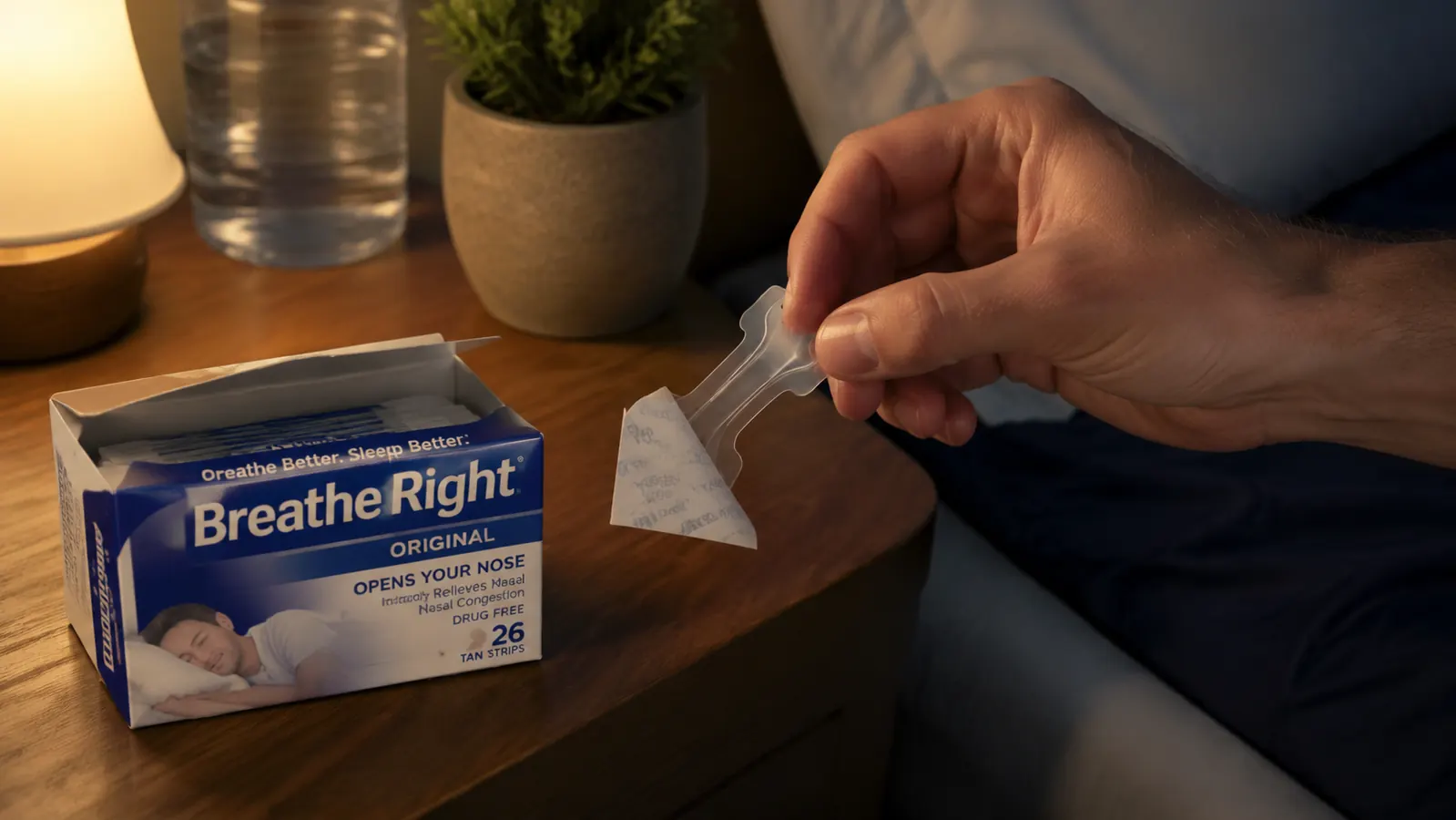
The routine is almost embarrassingly simple, which is honestly why I stuck with it for six months instead of quitting after a week like I do with most things I try for my health. I wash my face, dry off completely because the adhesive won't grip on damp skin, and press the strip across the bridge of my nose right before I get in bed. The little plastic bands inside pull the sides of your nostrils outward the second you press it flat, and you can actually feel your nasal passage open up within a few seconds.
Emma, our six-year-old, calls it my "robot nose" and asks to help me press it on some nights, which has turned into its own weird little bedtime ritual. Jonah, who's three, mostly just wants to wear one too, and I've had to explain more than once that these are for grown-up noses, not for stuffed animals, after he tried to strip one across his rabbit's face.
I didn't ease into this gradually. I wore one every night starting week one, through a head cold in month two, through the worst stretch of spring pollen in month four, and through several perfectly ordinary nights where nothing was wrong with my nose at all. I kept a note on my phone each morning scoring how congested I felt on waking and whether Casey mentioned hearing me snore. That's not a lab study, it's one dad's nightstand log, but six months of consistent data is six months of consistent data.
Our dog Biscuit has her own tell. She sleeps at the foot of our bed and used to reposition herself onto the floor whenever my snoring got bad enough to bother her. Some nights now she stays put on the bed the whole night, which I've started treating as a rough but honest barometer for how loud I actually was.
What's Actually Going On With the Strip
Breathe Right's Extra Strength Clear strips work through two thin, flexible plastic bands built into the adhesive backing. When you press the strip flat across your nose, those bands spring back toward their resting shape and physically pull the outer walls of your nostrils outward. It's not a spray, it's not a medication, it's straight mechanical leverage on the outside of your nose, which is exactly why there's nothing to absorb and nothing to build a tolerance to.
This particular version is labeled for sensitive skin, and after six months of nightly application and removal across the same patch of skin on my nose, I understand why that claim matters. I've got fair, easily irritated skin, and I braced for redness or that raw feeling you get pulling off a bandage too many times in one spot. It never showed up. The adhesive is strong enough to stay put through a full night of side sleeping and rolling around, but it peels off clean in the morning without taking a layer of skin with it.
One thing I noticed by around week five is that the strip works best when it's applied to bone-dry skin. Any residual moisturizer, or even skin that's just slightly damp from a shower, cuts the hold time noticeably, and I've woken up a couple mornings to find it dangling off one side. Once I started waiting the extra sixty seconds for my face to fully dry, that stopped being a problem.
A single box works out to a genuinely low cost per night once you're using one nightly, and I've never had a box run out faster than expected or a strip that felt flimsier than the one before it. There's no fiddly setup either, no fitting or sizing chart, you just tear one off the perforated sheet and press it on.
Six Months of Nightly Data
Week one was mostly about getting used to the sensation of tape across my face, which sounds trivial but genuinely took a few nights to stop noticing. By day four I'd stopped fidgeting with it before falling asleep, and by week two Casey told me, without me asking, that my snoring had gone from what she called a "chainsaw" to something closer to a soft hum most nights.
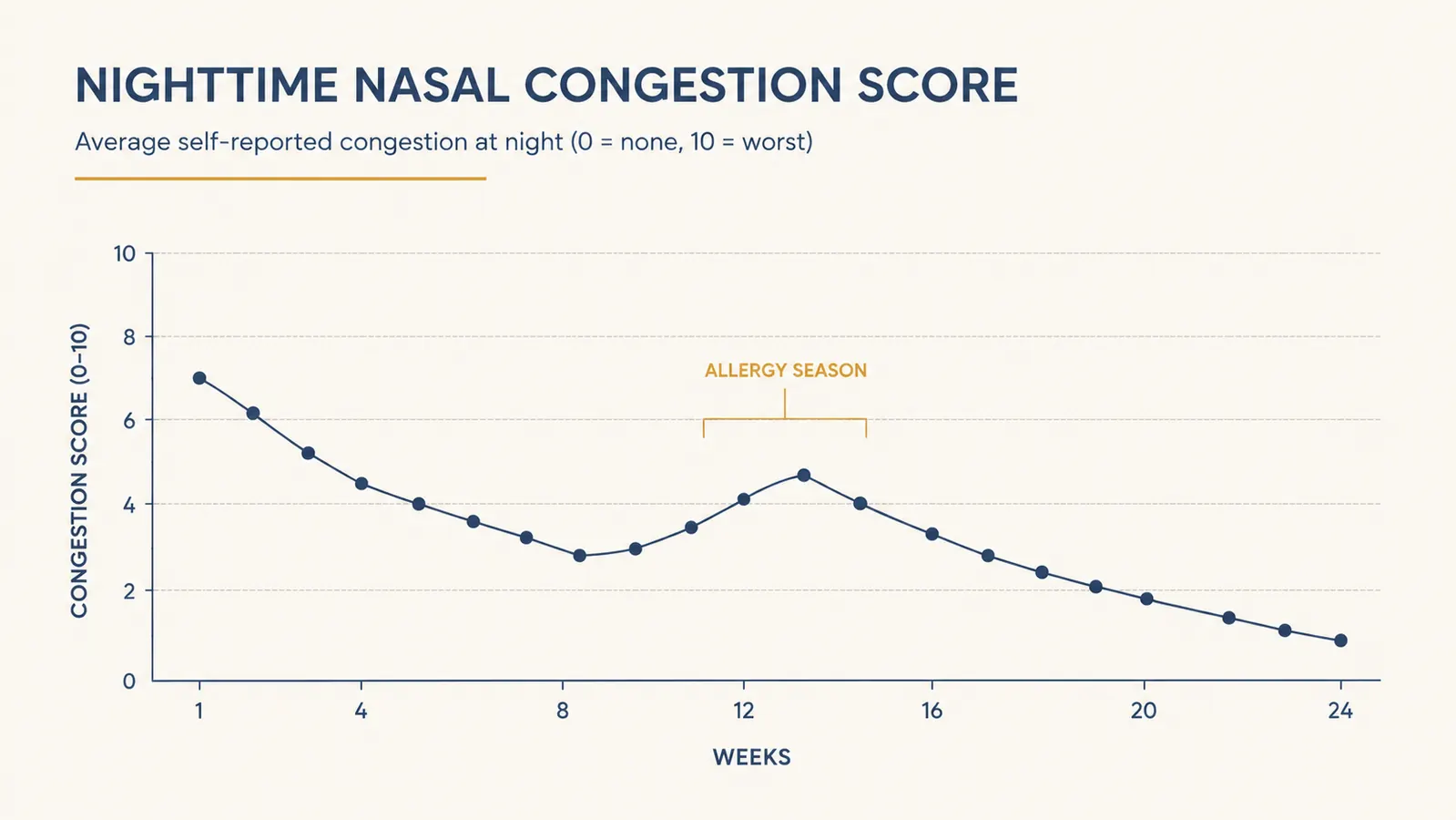
The real test came in month two when I caught a head cold. I was skeptical the strip would do much against actual congestion, not just the structural narrowness on my left side my allergist had mentioned. It genuinely surprised me. It didn't clear the cold, nothing short of time does that, but it noticeably widened the passage that wasn't already swollen shut, and I slept through two nights I would normally have spent mouth-breathing with a dry throat.
Allergy season in month four was the toughest stretch. My morning congestion scores, which had settled around a 1.5 out of 5 by month three, climbed back up toward 3 for about three weeks straight. The strip alone couldn't fully compensate for that much swelling, though Casey still said the snoring stayed quieter than it usually gets during pollen season without any intervention at all. By month five the scores had settled back down to that same 1.5 to 2 range and stayed there through month six.
Casey ran her own unofficial check around month five, spending three nights without her earplugs just to see if she'd actually notice a difference without them. She confirmed it, unprompted, over coffee one morning, which carried more weight with me than any number I'd logged myself. That's the kind of proof that holds up at the kitchen table when someone asks if a strip of plastic and tape can really change anything.
The Tradeoffs Nobody Puts in the Marketing
This is not a fix for a genuinely blocked nose. My allergist was clear that my left-side narrowing is structural, and the strip helps me breathe better through that side, it doesn't correct it. If your snoring comes from a real deviated septum or diagnosed sleep apnea, this belongs in the category of things worth trying alongside a doctor's guidance, not instead of one.
It's also a nightly consumable, not a one-time purchase. Unlike a reusable nasal dilator, every strip gets thrown away in the morning, so there's an ongoing cost and an ongoing trip to restock, even if that cost per night stays low. If you hate the idea of buying the same small box over and over, that's worth factoring in before you commit.
I also noticed the adhesive grabs a little bit of stray eyebrow or nose hair on the way off some mornings, which is a quick wince rather than a real complaint, but worth knowing if you're sensitive to that kind of thing. And on the handful of nights I forgot to fully dry my face after washing up, the strip came loose by 3 or 4 a.m. and I'd wake up with it stuck to my pillowcase instead of my nose.
Visually, it's not subtle. It's a clear strip, but it's still a strip across the middle of your face, and if you and your partner have separate bedtime routines or you travel for work and share hotel rooms with colleagues, that's a small dignity tax you're paying every night. I stopped caring about it around week three, but I know not everyone will.
Other Options I Considered First
Before settling into six months with these strips, I tried an internal nasal dilator for about ten days, the kind of small plastic device that sits just inside your nostrils rather than pulling from the outside. It worked, to a point, but I never fully got comfortable with something sitting inside my nose overnight, and I found myself removing it in my sleep more than once. If you want the full side-by-side breakdown between that style and this one, I put together a separate comparison covering exactly that tradeoff.
I also considered mouth tape for a stretch, since a fair amount of my nighttime noise comes from mouth breathing once my nose gets tired of working overtime. The two aren't really competitors, they solve different halves of the same problem. Opening the nose reduces the pressure that pushes you into mouth breathing in the first place, but taping addresses the habit directly if it's already set in. I ended up using both on my worst allergy nights, which honestly worked better than either one alone.
Cost-wise, the math was simple enough that I didn't agonize over it. A box lasts close to a month of nightly use, and there wasn't a cheaper drug-free option I found that came close to matching the hold and comfort over six straight months of daily wear.
What I Liked
- Drug-free, mechanical fix with nothing to absorb and no tolerance buildup over time
- Sensitive-skin adhesive that never irritated my nose across six months of nightly use
- Noticeably reduced my snoring on most nights, confirmed independently by my wife
- Simple, no-fitting setup, tear and press
- Held through a full night of side sleeping and rolling over, as long as skin was fully dry first
Where It Falls Short
- Doesn't correct a structural nasal block, only helps you breathe better around it
- Ongoing nightly cost since each strip is single use
- Adhesive loosens if applied to skin that isn't completely dry
- Not fully invisible, which matters if you share a room or travel with colleagues
Biscuit stopped sliding off the bed at night before Casey ever said a word about my snoring getting quieter. The dog knew before either of us did.

Who This Is For
This makes the most sense for someone whose snoring or nighttime congestion comes at least partly from a narrow or slightly obstructed nasal passage, whether that's from allergies, a cold, or a structural quirk like mine, and who wants a drug-free, low-commitment way to test whether opening that passage actually helps. It's also a good fit if you want an immediate, no-fitting solution you can start using the same night you buy it, without any adjustment period beyond getting used to the feeling of tape on your face.
It's worth trying if you're the person getting elbowed awake, or the one doing the elbowing, before you spend more on a reusable device or a specialist visit. Six months in, this is still the first thing I reach for on a night I know my allergies are acting up.
Who Should Skip It
Skip this if you've been diagnosed with moderate to severe sleep apnea and haven't talked to a doctor about your specific treatment plan, since a nasal strip alone isn't a substitute for that conversation. It's also not the right fit if you want a reusable, buy-once solution rather than a nightly consumable, or if the idea of anything visible across your face while you sleep is a dealbreaker for you, especially if you regularly share a room with someone outside your household.
If you've got young kids in the house like I do, keep the box somewhere they can't get into. Jonah once found an open box on the counter and tried to stick three strips onto his own face at once, which was more funny than dangerous, but it's a good reminder to store these up high rather than in a bathroom drawer at kid height.
Six months in, Casey sleeps without earplugs most nights now.
That's the whole review. It's a clear strip of plastic and adhesive that quietly did its job night after night, for less than the price of a coffee run each week.
Amazon Check Today's Price on Amazon →